
Hammertoe deformity of the toes is a problem that deserves attention and is often underestimated. At first, your toes begin to bend slightly — this may seem like a minor consequence of uncomfortable footwear or flat feet.
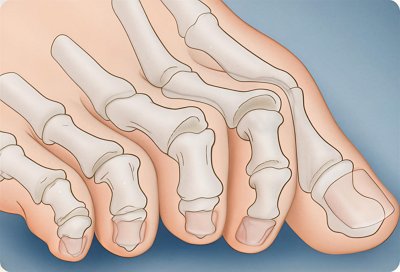 However, over time it becomes noticeable as it turns into a source of constant pain, thick callus formation on the feet, and discomfort while walking.
Our patient, Oleg, visited the center after he could no longer wear his favorite shoes and constantly experienced pain during walks with his children. “I thought it was a minor issue, but when the toe deformity started to interfere even at home, I realized something had to be done,” he shares.
At the Rudenko Medical Center, we take a comprehensive approach to the treatment of hammertoe deformities. Our specialists, orthopedic trauma surgeons, work not only with the visible deformity but also with its underlying causes. We follow modern principles and use up-to-date minimally invasive techniques that allow us to restore the natural shape of the toes and regain comfort while walking.
How does your foot change as hammertoe deformity develops?
The toe becomes deformed at the level of the interphalangeal joint due to angular flexion and gradually becomes fixed in a forced, unnatural position. Most often, the second toe is affected; less commonly, the third or fourth toe. In the early stages of the condition, the deformity can still be manually corrected, but over time the muscles and tendons adapt to the new anatomical conditions, a persistent contracture develops, and the joint loses mobility, leading to chronic pain.
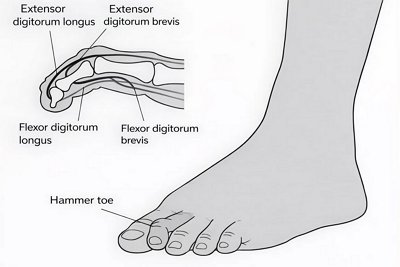
Most importantly, hammertoe deformity almost never occurs on its own. In most cases, it is associated with a specific set of predisposing factors:
- wearing tight, narrow shoes or high-heeled footwear
- flat feet and impaired foot biomechanics
- hallux valgus (“bunion” of the big toe)
- muscle imbalance of the foot, plantar fasciitis
- consequences of injuries, osteoarthritis, and rheumatic diseases
Hammertoe deformity of the toes is often only part of a complex problem, and the focus of treatment must be systemic; otherwise, the result will not be sustainable in the long term.
Why don’t conservative methods work?
In the early stages of toe deformity, patients try to change footwear and use orthotic insoles or silicone toe spacers. This may slightly reduce discomfort by redistributing pressure on the foot, but it does not eliminate the deformity itself.
The pain becomes constant, calluses and corns become permanent companions, and due to the deformity, foot functionality is limited, which subsequently affects not only the foot but the biomechanics of the entire lower limb. Surgical treatment is a radical but fully effective method for treating hammertoe deformities.
Surgery is not a sentence but the only optimal way to help you restore comfort and the joy of movement. Modern minimally invasive foot surgery makes it possible to achieve this quickly, gently, and without unnecessary inconvenience. “One-day” surgeries are a strong trend in modern surgery, working in favor of the patient.
Using the Rudenko Medical Center as an example
The path to a healthy foot begins with a detailed consultation with an orthopedic trauma surgeon at our center. Appointments are scheduled in advance — no long queues or waiting outside the office. The center operates at full capacity even during power outages.
The orthopedic trauma surgeon will collect your medical history, examine the foot, assess the severity of the condition, toe mobility, joint status, and all accompanying changes in the foot. In most cases, this is sufficient to determine the treatment strategy. However, additional diagnostic methods may be prescribed if necessary. This approach allows us to select the optimal treatment method for each patient, taking individual characteristics into account.
Our team of specialists fundamentally prioritizes minimally invasive techniques, which allow us to achieve results with minimal trauma to surrounding tissues. This is crucial for patient recovery, psychological comfort, and a rapid return to an active lifestyle.
Minimally invasive correction: how does it work?
Through small punctures, the orthopedic trauma surgeon at the Rudenko Medical Center performs correction of tendons, ligaments, muscles, or bone structures, restoring the natural axis of the toe.
This approach has undeniable advantages:
- virtually no blood loss
- no need for prolonged hospitalization
- minimal postoperative pain
- rapid reduction of swelling
- excellent cosmetic result with no large scars
- the ability to walk immediately after surgery
Our patients return to an active lifestyle within a few weeks after surgery and no longer experience discomfort when wearing shoes.
Key aspects in the treatment of hammertoe deformity
The orthopedic trauma surgeon at the Rudenko Medical Center evaluates not only the toe deformity but the entire foot as a functional anatomical unit. It is important to understand how load is distributed in the limb, which joints and muscles are involved, and what causes persistent pain. This approach ensures stable and long-lasting results, reduces the risk of recurrent deformity, and restores pain-free movement.
Why shouldn’t treatment be delayed?
Each month of delay increases the complexity of surgical correction. Joints lose mobility, soft tissues shorten and hypertrophy, remaining in a stable non-physiological position, and pain intensifies. Timely consultation with an orthopedic trauma surgeon at the Rudenko Medical Center allows for effective and gentle correction and restores full functionality of the foot.
Postoperative recovery
After minimally invasive correction, the patient uses special postoperative footwear that allows pain-free walking and minimizes stress on the recently operated limb. Early activity resumes faster than after traditional procedures, and most patients return to their usual lifestyle within 2–3 weeks.
A successful outcome includes restoration of the normal anatomical shape of the toes, absence of pain and chronic fatigue in the feet, the ability to wear favorite shoes, and full freedom of movement without reminders of the problem.
Do not delay until the pain becomes constant. Schedule a consultation with an orthopedic trauma surgeon at the Rudenko Medical Center today and restore comfort and freedom of movement to your feet. Your health deserves attention and care.