
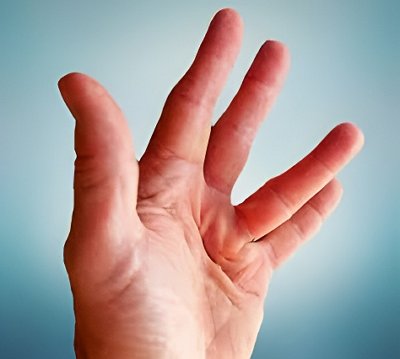
 In our daily routine, we don't notice how many movements our hands make and underestimate the criticality of the condition when they are affected by disease. But hand diseases definitely cannot be ignored, as a person's quality of life significantly decreases as soon as constant pain begins to overshadow even the smallest motor skills.
- Have callus-like nodules appeared on the palm of your hand?
- Are you bothered by a pulling pain and weakness in your hand?
- Have you noticed a slowly progressive flexion deformity of the 4th or 5th fingers?
- Are daily hand movements becoming uncomfortable and no longer possible to the same extent?
It is likely that it is Dupuytren's contracture. It is important to remember that a correct diagnosis can only be made after an examination by a specialist at the Rudenko Medical Center, an orthopedic traumatologist.
Palmar fibromatosis, better known as Dupuytren's contracture, is a benign degenerative-dystrophic process of replacing the physiological structure of the palmar aponeurosis with dense fibrous tissue.
This pathological condition is genetically determined and can be inherited. Also, among patients, the male gender prevails with an age category of 45+. Risk factors for the development of fibromatosis are also:
- History of hand injuries and bone fractures
- Occupational hazards – at risk are people whose profession is closely related to exhausting physical work with their hands
- History of rheumatological diseases affecting small joints
- Alcoholism
Dupuytren's contracture is based on slowly progressive degeneration of the palmar aponeurosis and, as a result, its shortening with impaired hand function.
Contracture has 4 stages of progression:
Stage One
It all starts with the formation of uneven, painless nodular formations in the area of the 4th and 5th metacarpal bones of the hand, which mimic a callus. At this stage, the deformation of the fingers is not yet visualized, and there is no pain syndrome and limitation of the functionality of the hand. Therefore, the contracture is mistakenly taken by patients for a callus, and the visit to the doctor is delayed until the hand begins to lose the volume of active movements.
Stage Two
Fibrous nodes of the palmar aponeurosis progressively increase, causing its shortening and tension. The nodes tend to merge with each other and involve the skin in the process, in the form of its retraction without signs of the inflammatory process. Flexural deformation of the fingers of the hand begins and periodic low-intensity pain syndrome appears. The hand at this stage already loses some functionality, which is what becomes the primary reason for seeking medical attention.
Stage Three
Large nodular deformation of the aponeurosis spreads closer to the fingers of the hand, the skin of the hand is deeply retracted, dries and peels. The hand acquires a characteristic appearance, loses the strength of compression and the ability to hold objects. Angular deformation of the fingers will reach 90 degrees, which is an indication for the start of active surgical treatment tactics.
Stage Four
On the palmar surface of the hand, a dense conglomerate of nodes of the altered aponeurosis is formed, and the angular deformation of the fingers reaches 90 degrees or less. In the terminal stage, fibromatosis may be accompanied by tendovaginitis, which will increase the activity of the pain syndrome in the hand.
 Diagnosis of palmar fibromatosis
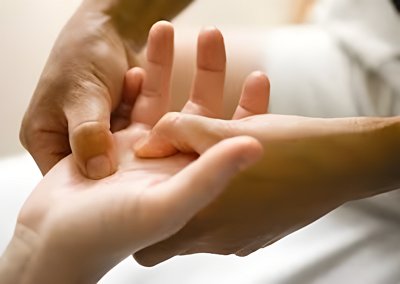
Dupuytren's contracture can be diagnosed during the initial examination by a traumatologist at the Rudenko Medical Center. The doctor assesses the degree of fibromatosis, the extent of preserved hand functionality, and determines treatment tactics, maintaining the most personalized approach.
Additionally, radiography of the hand in standard projections may be used as indicated to exclude destructive bone processes.
Treatment of Dupuytren's contracture or "cut cannot be done conservatively"
Experienced specialists of our center will not have any doubts about where to put the comma in the above, depending on the clinical condition of the patient. Conservative tactics of managing patients with palmar fibromatosis are permissible and effective only in the first two stages of disease progression. This is exactly the case when a competent approach to physiotherapeutic methods and injections of enzymes of the hydrolase class can not only partially reduce the severity of the pathological process and improve the quality of life, but also postpone surgical intervention. Dupuytren's contracture is a recurrent disease, so it is important to remember that any conservative methods provide only a temporary effect, and surgical treatment is a radical approach that completely eliminates the nodular deformation of the palmar aponeurosis and restores the functionality of the hand.
The most relevant today is selective fasciotomy of the palmar aponeurosis.
This surgical intervention aims at total excision of scar-changed areas of the aponeurosis with simultaneous plasticity of the hand tissues. In the case of significant involvement of skin tissues in the scar deformation, dermofasciectomy will be performed, the actual excision of the nodes together with the skin. The surgical intervention is usually performed under local anesthesia, but in complex clinical cases, general anesthesia may be used. Surgical treatment of palmar fibromatosis does not require a long stay in the hospital, so you can return to your usual life the same or the next day.
After surgery, the hand will need to be fixed with a plaster splint for 7-10 days, which should be taken into account when building your daily schedule. And after 6 weeks, there will be no memory of the surgery.
A small but skillful surgical intervention that will significantly improve the quality of your life is the surgical treatment of Dupuytren's contracture at the Rudenko Medical Center.
Hand surgery is a delicate and delicate branch of surgery, where professionalism and experience are required to preserve the integrity of the vascular and neurovascular bundles of the hand and achieve maximum restoration of its function. The Rudenko Medical Center has many years of experience in hand microsurgery, works with the most complex clinical cases and actively implements the latest knowledge and techniques in its everyday work.