
 When surgery is not a sentence, but a guarantee of quality of life.
When you return home after a day at work, can't you get rid of the feeling of a "pebble" in your shoe? And when you try to relax your foot, you get a burning sensation and shooting pain?
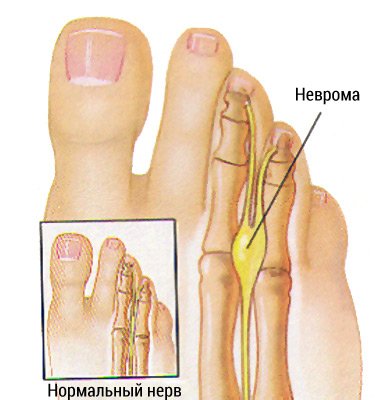
Morton's neuroma is a benign thickening of the interdigital nerve, most often in the area between the third and fourth toes of the foot, less often between the 2nd and 3rd. It is usually a unilateral process. This condition is only conditionally called a neuroma, but in fact it is a fibro-inflammatory spindle-shaped thickening of the nerve, which occurs as a result of its chronic compression.
In the early stages of the disease, symptoms can be managed conservatively, but in most cases, the choice will be in favor of surgical treatment.
How and why does Morton's neuroma occur?
The root cause of the development of neurinoma is considered to be overloading the foot and improper distribution of pressure on it. A foot in improperly selected shoes, heels or involved in professional athletics begins to change the biomechanics of movement. Accordingly, chronic microtraumatization of the nerve develops, which is prone to structural restructuring. The interdigital nerves are compressed, a local inflammatory process occurs, which provokes nerve compression and the formation of a nodule.
It is always best to start treatment for Morton's neuroma with the simplest – conservative. First – lifestyle changes:
- selection of the right anatomical shoes
- physiotherapy procedures to reduce the manifestations of the inflammatory process
- use of orthopedic insoles
- performing daily exercises for effective relaxation of the foot
Also, local injections of corticosteroids are used to eliminate the inflammatory process.
If none of the options relieves the pain syndrome, daily activity is significantly limited, complaints persist for six months or more, and additional imaging methods clearly show a neurinoma nodule, the question of surgical intervention will become relevant.
Surgical treatment of neurinoma at the Rudenko Clinic
Our medical center offers several modern and most effective approaches that have proven themselves in the medical community.
The choice of method will be determined by the patient's clinical condition, the severity of symptoms, and the location of the neuroma.
1) Neurinomectomy
The essence of the method is the radical removal of the affected nerve.
The operation is performed through a small incision in the skin, the neuroma is removed together with the altered segment of the interdigital nerve. As a result, after surgery, the patient may experience a decrease in sensitivity at the level of the surgical intervention. But this does not cause discomfort and does not affect the quality of life at all, the main thing is that the pain in the foot will no longer be bothersome.
2) Decompression
This option may be relevant for the early form of the disease.
During the intervention, the surgeon dissects the interosseous ligament that compresses the neuroma, without removing it directly. This relieves pressure on the nerve and will prevent postoperative loss of sensitivity, as in the case of radical removal.
3) Minimally invasive techniques
More and more often, surgery seeks to solve the patient's problem as quickly as possible and return him to normal life. Our medical center also works in the direction of one-day surgery.
- Minimal blood loss
- No general anesthesia
- No need for hospitalization
- Short recovery period
All these are advantages of minimally invasive techniques, such as cryodestruction, radiofrequency ablation, and laser vaporization.
After any intervention on a neuroma, it is necessary to give the foot time to recover, avoid putting pressure on the operated part of the foot, and ensure effective postoperative anesthesia and cooling of the operated area.
It is necessary to understand that any surgical intervention, radical or minimally invasive, does not guarantee the absence of recurrence of neurinoma. Therefore, it is worth making maximum efforts to modify lifestyle, as well as to develop healthy shoe habits. Choose shoes with a wide anatomical toe, soft sole and made of softer types of leather or textiles, use orthopedic insoles to maintain the height of the arch of the foot and correctly distribute the load on it. Avoid heavy tractor soles, heels and shoes without an anatomically shaped insole.
Your health is our priority. Rudenko Medical Center is always ready to help, even in the most difficult clinical cases. We meet the expectations of our patients and get the most effective results that they will definitely be satisfied with.