
People decide to undergo hip replacement with the sole purpose of regaining full daily activity without pain or any restrictions. But will all these limitations really disappear immediately after the prostheses are fitted and you can return to your usual routine right away? The specialists of our medical center, orthopedic traumatologists, will tell you about this and other features of rehabilitation after such interventions.
Rehabilitation after hip replacement at Rudenko Clinic in Zaporizhzhia
Rehabilitation after hip replacement is a diligent daily work of each patient, and it is with perseverance and discipline that almost complete restoration of joint functionality can be achieved.

- You will take the first steps after surgery with the support of a doctor and the help of an exercise arena. This will allow you to prevent feelings of weakness when moving. You need to support yourself on the exercise apparatus or crutches, and walk only on the healthy leg. The operated leg should only touch the floor, and the leg should be completely at rest for the first weeks after surgery. Physical activity on the operated leg can be started in 3-4 weeks after the arthroplasty. The walking time should be increased gradually, the load should be increased in a dosed manner, but the amplitude of movements with the operated leg should be minimal, and the movements themselves should be accurate.
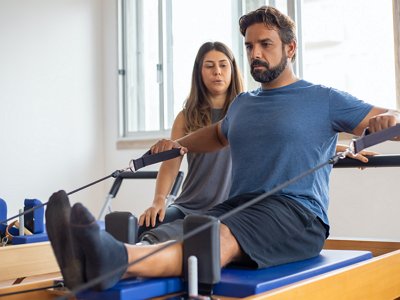
- The early rehabilitation period will be aimed at improving blood microcirculation in the periarticular tissues, healing the postoperative wound and preventing early complications. An occupational therapist will develop an individualized plan of light, comfortable training for you to help you gently transition from the hospital room to daily activity. Short walks in the park, as well as water aerobics will have a positive effect on blood circulation in the tissues, which will speed up recovery after arthroplasty.
- Physiotherapeutic procedures have a general strengthening effect on the body, improve well-being and provide a mild analgesic effect. Therapeutic exercise and massage can be used in a dosed manner in consultation with a doctor. Kinesiotaping and reflexology techniques are widely used, allowing for localized effects on the human body, both toning and relaxing.
- In the long-term rehabilitation period, the volume of physical activity will increase significantly to form a strong muscle frame around the joint. This stage will require full commitment from the patient, as it will take place at home.
Gradualism, dedication, continuity, and responsibility are the key to successful rehabilitation and depend on you.
The doctor will definitely draw your attention to the restrictions that must be observed immediately after the intervention, namely:
- you should keep the correct position of the operated leg
- Do not bend forward
- do not cross your legs or bend the operated leg at an angle of more than 90 degrees
- do not jump or wear heels
- for several nights after the operation, you should sleep only on your back, you should not lie down on the healthy side for about two weeks
- when climbing stairs, you should put your weight on your healthy leg and lift the operated leg behind you.
- when going down the stairs, put crutches on the lower step first and then step down later.
What is hip replacement?
This is a surgical intervention aimed at replacing the components of the hip joint with artificial ones under various conditions. Fractures of the femoral neck, osteonecrosis of the femoral head, and the consequences of Perthes disease are all reasons why a person will need hip prosthetics. Today, prostheses are made of absolutely biocompatible materials, metal alloys or cermets. Patients do not have to worry about implant rejection, as the modern prosthetics industry pays maximum attention to the issue of their bioinertness and possible reactions of the human body. The durability of modern implants is measured in decades, but it all depends on the patient's physical activity, the presence of concomitant pathologies and the individual characteristics of each person. Fixation of endoprostheses at the site of their location can be done by cement or mechanical means.
In general, there are three types of endoprosthetics:
- Total: mono- and bipolar, depending on the design of the prosthesis itself
- Unipolar: only the femoral head is replaced
- Revision
Prevention after arthroplasty

- The first and main postulate of successful rehabilitation is early patient activation
- Prevention of thromboembolism
- Healthy lifestyle
- Blood pressure control
- Weight control
- Control of infectious complications
- Medical support
Your life will change for the better after arthroplasty and an effective rehabilitation process. You will be able to enjoy your usual rhythm, do your favorite sports, take long walks in the park and not think about hip pain. Rudenko Medical Center knows how to help you with this. Contact us by phone +38(066)8678727, and we will be happy to answer any additional questions.
Take care of your health with Rudenko Clinic in Zaporizhzhia.