
Ukraine’s healthcare system today offers unprecedented freedom: patients can independently choose the level of medical care — from a family doctor to a highly specialized surgical hospital. However, with the expansion of opportunities, the dilemma of choice has also emerged.
On one hand, there are public healthcare institutions that guarantee basic accessibility and financial protection in conditions of economic instability. On the other hand, there is the rapid development of private medicine, where individual approach and speed of rehabilitation are the main priorities. In the field of joint replacement surgery, both formats have their own pros and cons that directly affect the patient’s quality of life after the operation.
However, in planned medical situations, there are fundamental differences between the two systems that influence the patient’s decision.
What should you know when choosing which healthcare system to use?
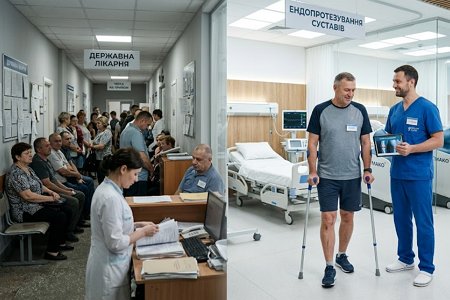
Like any system, each format of medical care has its own advantages and disadvantages. These aspects concern not only doctors, but first and foremost the patient, especially those who require joint replacement surgery.
First of all, it is worth noting that joint replacement surgery is a high-tech surgical intervention aimed at replacing a natural joint with a biocompatible artificial structure that will fully perform the function of the lost joint. This type of procedure is planned, meaning the patient always has time to choose the most suitable treatment path.
The main advantages of private healthcare remain:
- minimization of bureaucratic procedures
- access to the best technological solutions
- service quality
Bureaucracy
This is an undeniable leader among the advantages of private medical institutions compared to public healthcare facilities. There is no need to wait for appointments with doctors, referrals, consultations with specialists, or collect numerous certificates and permissions, especially during wartime, when public healthcare faces strict limitations regarding hospitalizations and surgical interventions. Patients often choose to save their time rather than spend weeks gathering documents confirming the necessity of their treatment in order to be admitted to a public healthcare facility.
In the private healthcare sector, there is no need to justify the choice of a specific type of implant.
A private clinic allows the patient to make decisions together with the attending physician according to personal preferences, needs, and clinical indications. All of this happens as quickly as possible, in close communication with suppliers and without additional bureaucratic obstacles.
Access to Technology
It is no secret that choosing the best always comes at a cost. From international training programs for orthopedic surgeons to the quality of even the smallest surgical consumables — every aspect is expensive. Public healthcare, despite striving for maximum development during wartime, remains limited by funding, the need for lengthy procurement tenders for equipment and supplies, and extremely restricted budgets for high-quality professional training.
Meanwhile, the private sector is ready to invest both in specialists and in technological capabilities in order to improve every day. This directly affects the quality of surgical procedures, the speed of rehabilitation after joint replacement surgery, and ultimately the effectiveness of treatment for the patient.
Service
Patients always want to be heard, to receive attention to their problem, and to have privacy so they can experience a calm and comfortable atmosphere during such a physically and psychologically difficult period.
The staffing shortage in public healthcare institutions during wartime is also highly significant in the context of providing medical care to the population. Hospitals are never empty, especially during war. The number of people needing assistance is often much greater than the available facilities and human resources in public healthcare institutions. Therefore, it is physically impossible to provide sufficient attention to every patient under such overwhelming working conditions. The formal approach to communication is caused not only by the large patient flow, but also serves as a form of protection against professional and emotional burnout among healthcare workers.
Private medical institutions compete with public healthcare not only through technology and service, but also through patient-centered care. People want to receive help quickly, easily, without exhausting queues, and with maximum efficiency. This is exactly what the private sector provides in the field of joint replacement surgery. Today, “turnkey” operations are no longer unique — they are the standard of quality healthcare. From the first step into the clinic and the opportunity to ask specialists any questions during consultations to individualized rehabilitation sessions after surgery — all of this reflects the modern approach to patient care in private medicine.
Every advantage of a private healthcare institution is driven by care for the patient, their need for peace of mind, and confidence in the final result. For our patients, medicine becomes not only a way to get rid of pain, but also a place where they can feel secure and cared for.
In modern conditions, patients increasingly choose not just a hospital, but the quality of their treatment experience. People want to be heard, to have diagnoses explained in understandable language, not to wait weeks for examinations, and to be treated with respect. This is exactly what drives the growing popularity of private healthcare today. Although there is no perfect universal solution for choosing a healthcare system, recent trends leave little doubt. Patients increasingly value their time, comfort, and a personalized approach. That is why the private healthcare sector continues to grow, set new standards, and improve the quality of its services so that every patient receives the best possible outcome they deserve.