
Knee pain after a workout, an awkward twist, or even a regular walk is often perceived as a temporary problem. However, if the pain is accompanied by:
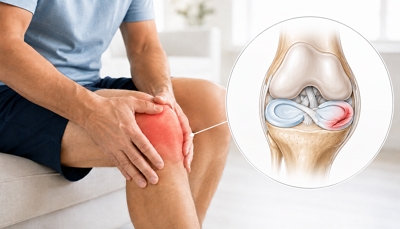
- clicking,
- a feeling of instability
- or locking of the joint,
this may indicate a meniscus injury. The menisci act as natural shock absorbers in the knee joint, distribute the load, and protect the articular cartilage from premature wear.
In this article, orthopedic doctor Roman Rudenko explains why meniscus injuries occur, which symptoms should not be ignored, how modern diagnostics are performed, and which treatment methods help preserve the patient's natural joint as much as possible.
What is the meniscus and why does it get injured?
Each knee joint has two menisci – the medial (inner) meniscus and the lateral (outer) meniscus. They are made of dense cartilage tissue and perform several important functions at once: they absorb impact, stabilize the joint, and protect the articular surfaces from damage.
One of the distinctive features of the menisci is their blood supply. Only the peripheral part has a good blood supply, while the central part has almost no blood vessels. This is why some tears can heal with proper treatment, while others require surgical intervention.
Meniscus injuries most often occur during a sudden twisting movement of the body while the foot remains fixed, which is common in football, basketball, tennis, and skiing. In older people, the cause is often degenerative changes associated with osteoarthritis. Sometimes the injury is combined, when even a minor load causes a tear in already weakened tissue.
Meniscus tears may be longitudinal, radial, horizontal, or bucket-handle tears. The latter type often causes knee locking and may require urgent treatment.
Symptoms of a meniscus injury: when should you see a doctor?
A meniscus injury does not always cause sharp pain immediately after trauma. Sometimes the symptoms develop gradually.
The main signs include:
- pain along the joint line;
- knee swelling;
- clicking during movement;
- a feeling of a foreign object inside the joint;
- knee locking or blockage;
- inability to fully bend or straighten the leg.
A particularly concerning situation is when the pain disappears after a few days but returns after physical activity or prolonged walking. This may indicate a chronic meniscus injury that gradually leads to damage of the articular cartilage and the development of osteoarthritis.
Why does an X-ray not always reveal the cause of knee pain?
A normal X-ray result does not always mean that there is no pathology. An X-ray clearly visualizes bone structures but does not allow a full assessment of the menisci, ligaments, and soft tissues of the knee joint.
That is why magnetic resonance imaging (MRI) is considered the gold standard for diagnosis. It allows the doctor to determine the location, type, and depth of the tear, as well as assess the condition of other structures within the knee.
A clinical examination by an orthopedic traumatologist is equally important. Special functional tests can help identify a suspected injury even before the MRI results are available and determine the optimal treatment strategy.
Modern treatment of meniscus injuries
The treatment strategy depends on the type of injury, its location, the patient's age, level of physical activity, and how long ago the injury occurred. Therefore, the approach is always individualized and based on accurate diagnostics and the clinical picture.
In many cases, conservative treatment is effective, especially when dealing with partial or stable injuries. It may include temporary limitation of physical activity, the use of an orthosis, medication therapy, therapeutic exercise, PRP therapy, or hyaluronic acid injections. In cases such as meniscus injuries, it is important not simply to relieve the symptoms but to address the cause of the injury and create the conditions necessary to restore joint function.
If the tear causes joint locking, instability, or conservative treatment does not provide the desired result, minimally invasive surgery – knee arthroscopy – may be recommended. This modern technique makes it possible to work through two small punctures instead of making a large surgical incision, preserving the integrity of the surrounding tissues as much as possible.
During arthroscopy, a high-resolution camera is inserted through one access point, allowing the surgeon to examine the condition of the meniscus and other intra-articular structures in detail. Special microsurgical instruments are introduced through the second access point to perform the necessary procedures, ranging from partial treatment of the damaged tissue to suturing the tear. This approach significantly reduces tissue trauma, shortens the recovery period, and allows the patient to return to an active lifestyle sooner.
Modern orthopedics follows the principle of preserving as much of the meniscus as possible. Whenever possible, the doctor performs meniscus repair and suturing, because the patient's natural meniscus protects the joint from the development of osteoarthritis much better than complete removal of the meniscus.
Rehabilitation after treatment
Properly organized rehabilitation is just as important as the surgery itself.
- The first stage lasts approximately one week. The main goal is to reduce pain and swelling, maintain muscle tone with isometric exercises, and use crutches if necessary.
- From the second week, the range of motion is gradually restored. Flexibility exercises, swimming, and stationary cycling without excessive load are added to the rehabilitation program.
- Starting at approximately the sixth week, the focus shifts to strengthening the thigh muscles, improving coordination, and gradually returning to sports activities.
After partial meniscus resection, most patients return to their normal lifestyle within 4–6 weeks. If meniscus repair and suturing were performed, full recovery may take 3–4 months because the tissue needs sufficient time to heal.
How can you reduce the risk of injury?
It is impossible to completely eliminate the risk of a meniscus injury, but it can be significantly reduced.
Before physical activity, it is important to perform a proper warm-up, maintain a healthy body weight, regularly strengthen the quadriceps and hamstring muscles, use proper sports techniques, and avoid ignoring even minor knee pain.
Do not postpone a consultation with a doctor
If you have knee pain, clicking, swelling, or a feeling that the joint is locking, you should not wait until the symptoms become more severe. Timely diagnosis makes it possible in many cases to preserve the meniscus and prevent the development of osteoarthritis.
Schedule a consultation with an orthopedic traumatologist at our clinic in Zaporizhzhia or learn more about the treatment of meniscus injuries and modern knee arthroscopy. Seeking professional medical care early is one of the best investments you can make in the health of your knees.