
The knee joint ceases to be a simple anatomical area as soon as it starts to hurt and change the quality of your life. It is a shock absorber in our body that reacts to every movement, coordinating it and providing a vector that balances our body not only during activity, but also when we are just standing.
 If this mechanism should “get sick”, the only daily question will be: will I need surgery to get my life back without pain?
Often, surgery becomes the last step in the long-term treatment of joint pain. Indeed, physiotherapy, drug therapy combined with hyaluronic acid injections and a healthy lifestyle will postpone surgery and allow you to maintain knee health for as long as possible.
When the possibilities of a conservative approach are exhausted, the knee will remind you of its needs with daily pain and the inability to move normally. Then the orthopedist of the Rudenko Medical Center will ask you: "When are we planning a knee replacement surgery?"
HOW TO UNDERSTAND THAT IT'S TIME TO GET INTENSE?
Several signs that will signal to you that the joint needs qualified help:
- Chronic pain during movement and rest
It is quite alarming when the pain in your joint does not subside day or night. It significantly worsens the quality of your life, forcing you to constantly think about painkillers.
- Restrictions on movement
When going down stairs becomes a real challenge, and tying shoelaces is almost impossible without help.
- Changing appearance
Over time, you will notice a deformity in the joint that develops in response to its chronic forced position.
These signs often indicate the final stages of degenerative changes in the joint or the consequences of severe injuries, when the natural joint fluid and cartilage no longer perform their function as before, losing moisture and with it elasticity.
WHEN DOES DELAYING SURGERY BECOME DANGEROUS?
Fear leads people to postpone knee replacement surgery until the last minute, despite the unbearable pain. But in matters of health, this strategy is not acceptable.
Chronic pain forces a person to change the biomechanics of their movements, adapting and looking for the most painless way to maintain the volume of their usual movements. Then not only does the joint deformity occur, but the ergonomics of the knee muscles and the redistribution of loads on the ligamentous apparatus also change. All this will be a difficult task for a rehabilitation specialist, whose task will be to return you to physiological movements in the knee without injuring the previously compensatory hypertrophied muscles. In addition, constant pain and movement restrictions will gradually lead to a decrease in physical activity, excess weight and problems with the cardiovascular system.
HOW IS KNEE REPLACEMENT SURGERY PERFORMED?
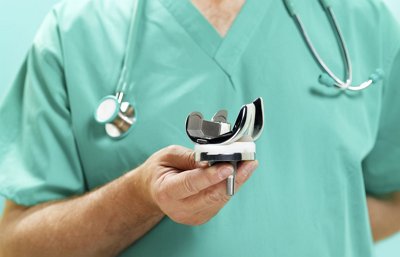
Knee replacement surgery at the Rudenko Medical Center is a high-tech process, the key to its success is the experience of our orthopedic traumatologists. The functionality of your knee joint and the quality of your life depend on their skill. The surgeon removes the destroyed areas of bone and cartilage, and in their place installs an artificial joint made of metal, ceramics or special plastic. Prostheses are selected individually, taking into account the anatomical features of the patient, the level of activity and even lifestyle.
The duration of the operation itself is usually 1.5–2 hours, and you can learn to get up and walk the next day. Ahead is a rehabilitation period that will last 3-6 months, but the result will be worth your efforts: the pain will disappear, you will be able to move in your usual rhythm, no restrictions and constant medication.
WHAT MOST COMMONLY SCARES PATIENTS BEFORE KNEE REPLACEMENT?
There are still many myths in the context of knee replacement surgery. One of the most common is: “Replace the joint again after 5 years.” In fact, modern prostheses are designed to last 15–20 years, and sometimes longer, depending on the patient’s lifestyle. Another myth is “You can’t play sports after knee replacement.” You can, but choose gentle activities: swimming, Nordic walking, cycling.
Another fear is experienced by people who have a large number of concomitant diseases. Here, the general state of health is more important than the passport age. There are many examples when people at the age of 75–80 successfully underwent endoprosthetics and after a few months led an active lifestyle.
Every patient should remember that the final decision about knee replacement surgery at the Rudenko Medical Center is made by you. The orthopedic traumatologist will provide all reliable information about the benefits, risks, and nuances of surgical intervention. The decision to have surgery should always be based on objective examination data, X-ray or MRI, analysis of the effectiveness of previous treatment, and your personal expectations.
Knee replacement is not the end, but the opportunity to live without pain. It is a chance to regain mobility, and with it - freedom and joy of life. Yes, the operation requires courage. But sometimes it becomes the only way to get out of the chair again and go towards your own dreams together with the Rudenko Medical Center.