
The leading trauma surgeons at the Rudenko Medical Center have prepared clear, comprehensive answers to the most common questions asked by patients experiencing shoulder pain.

Shoulder pain is one of those complaints people often dismiss. “I carried something heavy,” “I slept in an awkward position,” “It will pass.” Yet the shoulder is a complex structure with many components, and dysfunction in any of them may result in pain. Specialists at the Rudenko Medical Center frequently see patients who seek help only once the discomfort becomes persistent or begins interfering with daily activities. In many such cases, what seemed like ordinary fatigue turns out to be scapulohumeral periarthrosis — a degenerative and inflammatory condition of the periarticular tissues that requires targeted treatment rather than rest alone.
If the discomfort appeared after physical exertion, eased within a few days, does not disturb sleep, and does not limit movement, it is likely simple muscle strain. However, if:
- the shoulder hurts at night
- the pain does not depend on arm position
- you have to search for a comfortable sleeping posture
- sharp pain in the shoulder disrupts daily routines
— these are signals that the inflammation has progressed to a stage that will not resolve without medical treatment.
Scapulohumeral periarthrosis is not a classic “joint disease.” The joint surfaces may appear normal, without degenerative changes, yet the patient still experiences discomfort. The underlying issue often lies in the surrounding structures — the tendons, capsule, ligaments, or bursa — which may become irritated due to overload, prolonged static posture, or older injuries. These components work together as a unified system, and when one element is affected, the entire shoulder mechanism suffers.
A key clinical sign is the so-called “painful arc”. When lifting the arm forward or to the side, pain appears only between approximately 90° and 120°. Below and above this range, movement remains relatively comfortable. This pattern results from swelling in the subacromial space and irritation of the rotator cuff tendons, which experience the greatest friction in this position. It is a simple but highly informative test for diagnosing inflammatory changes in the periarticular tissues.
Treatment of scapulohumeral periarthrosis
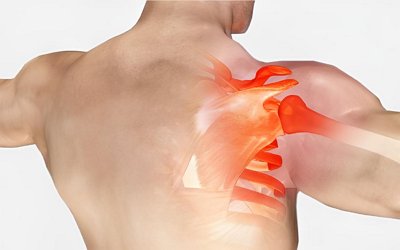
Management of periarthrosis is always comprehensive and may include:
- anti-inflammatory medication
- physiotherapy to enhance blood supply and tissue healing
- rehabilitation exercises to stabilize the shoulder
- injection therapy for significant pain
Trauma specialists at the Rudenko Medical Center emphasize that attempting to “work through” shoulder pain may worsen the condition. Inflammation must be reduced first; only then can full movement be safely restored.
In more advanced cases, where structural abnormalities cannot be addressed conservatively, arthroscopy may be required. This minimally invasive procedure allows the surgeon to remove inflamed tissue, assess the joint from the inside, and rule out additional causes of pain.
Humeral head cyst: a hidden but significant finding
Another important contributor to shoulder pain is a humeral head cyst — a benign lesion often associated with reduced blood supply (avascular necrosis) in a localized area of bone. MRI or CT is required for diagnosis, as standard X-rays often fail to detect these cysts.
A cyst typically appears as a round cavity with clear borders in the region of tendon attachment. Even small cysts can provoke persistent aching pain, especially during rotational movements, due to their proximity to key tendon insertions. When evaluating imaging, the doctor considers the cyst itself as well as associated findings — tendon condition, soft-tissue swelling, capsule changes, and possible injuries.
These cysts are benign and do not pose systemic health risks, but they often intensify pain in cases of scapulohumeral periarthrosis. In some instances, minimally invasive decompression is performed to improve blood flow in the affected part of the humeral head. If no cyst is present, treatment typically focuses on physiotherapy, rehabilitation, massage, shockwave therapy, and targeted injections.
Differential diagnosis: why shoulder pain can be misleading
Shoulder pain can be deceptive, sometimes mimicking cardiac issues, cervical spine disorders, neuralgia, or even gallbladder conditions. This explains why patients often consult several specialists before reaching a trauma surgeon.
During the consultation, the trauma surgeon performs a detailed examination, assesses movement, muscle strength, pain location, and conducts specific diagnostic tests. Only by combining these findings can the true cause be identified — periarthrosis, impingement syndrome, early tendon damage, or a humeral head cyst.
Timely evaluation and treatment are essential to prevent shoulder pain from becoming a long-term issue. Do not ignore persistent symptoms — early intervention leads to better outcomes.