
When bones or joints start to hurt, many people immediately think about vitamin D. Especially in autumn and winter, when there is less sunlight. This often leads to a simple assumption: “I probably have a deficiency – I should get tested and start taking vitamin D.”
Sometimes this suspicion is justified. However, pain in the bones, muscles, and a specific joint are not the same thing. The causes may differ, so it is not reasonable to explain every type of discomfort by a deficiency of one vitamin.
1. Why bones and joints hurt and what vitamin D has to do with it
Vitamin D is involved in calcium and phosphorus metabolism and is essential for normal mineralization of bone tissue. Part of the vitamin D in the body is produced in the skin under the influence of sunlight, while another part comes from food and supplements. It is then converted in the body into active forms that perform various functions.
If vitamin D levels are insufficient, this may affect the condition of bones and muscles. The problem is especially relevant for people who spend little time in the sun, older adults, people with excess body weight, and those with certain disorders that affect nutrient absorption.
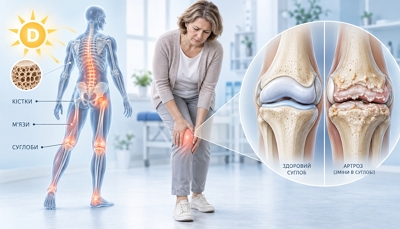
Vitamin D deficiency does not always cause obvious symptoms. Possible manifestations include:
- fatigue;
- muscle weakness;
- discomfort or pain in the musculoskeletal system;
- in cases of severe and prolonged deficiency – impaired bone health.
The difficulty is that these symptoms are nonspecific. They may occur with many other conditions, so vitamin D deficiency cannot be determined based on symptoms alone.
A blood test for 25(OH)D is used to assess vitamin D status. However, even the test result is not interpreted in isolation. A doctor evaluates it together with the patient's symptoms, medical history, and other relevant factors.
In the video, the doctor explains in more detail how vitamin D works, who may benefit from monitoring its level, and why the principle “the more, the better” does not apply in this case.
2. Pain in a specific joint and the features of osteoarthritis
If pain has a clear location – for example, if one knee, hip, or another joint hurts repeatedly – the cause should not be sought only in the general condition of the body.
Joint problems often cause pain that becomes worse during walking, climbing stairs, squatting, running, or other physical activity. Over time, stiffness, clicking or cracking sounds, swelling, or limited mobility may also appear.
One possible cause of these symptoms is osteoarthritis. It is not simply a condition in which the cartilage has “worn away.” Osteoarthritis gradually affects different structures of the joint, including cartilage, bone tissue, the synovial membrane, ligaments, and other tissues.
Age is one of the risk factors, but osteoarthritis cannot be considered an exclusively age-related disease. Its development may be influenced by:
- previous joint injuries;
- excessive or repetitive physical stress;
- excess body weight;
- anatomical features of the joints;
- certain medical conditions.
For this reason, osteoarthritis can also occur in relatively young people. At the same time, joint pain does not always mean osteoarthritis. Similar symptoms may be associated with injuries, meniscus damage, ligament injuries, overuse, and other conditions.
3. How to distinguish vitamin D deficiency from osteoarthritis
A single symptom is not enough to tell the difference. A doctor considers the nature of the pain, its location, its relationship with physical activity, and any accompanying symptoms.
If a person experiences general body aches without a clear location, muscle weakness, or other nonspecific symptoms, insufficient vitamin D status may be considered among the possible causes. However, this can only be confirmed with appropriate testing.
If pain repeatedly occurs in one joint and is associated with physical activity, the condition of that particular joint should be evaluated. This is especially important if the pain is accompanied by:
- stiffness;
- swelling;
- cracking or clicking sounds;
- limited range of motion;
- a feeling of instability or joint locking.
At the same time, it is not always necessary to choose between one condition and the other. A person may have both insufficient vitamin D levels and osteoarthritis. This is why the cause of pain should not be self-diagnosed, and treatment should not be started based on symptoms alone.
Vitamin D should also not be taken automatically for any pain in the bones or joints. If there are indications, a doctor may order a 25(OH)D blood test and determine whether correction is needed. Taking high doses without medical supervision is also undesirable, as excessive vitamin D can be harmful.
If vitamin D levels are normal but a specific joint continues to hurt, this is a reason to look for another cause. Possible explanations include osteoarthritis, the consequences of an injury, overuse, meniscus problems, ligament injuries, or other structural abnormalities.
4. When it is necessary to see a doctor
You should not wait for months hoping that the pain will go away on its own. Medical consultation is recommended if symptoms persist, regularly return, or gradually become worse.
It is especially important to seek medical attention if:
- the joint becomes swollen or changes shape;
- movement becomes noticeably restricted;
- there is a feeling of instability or joint locking;
- pain interferes with walking, working, exercising, or sleeping;
- symptoms appeared after an injury;
- the pain gradually becomes more severe or begins to occur even without physical activity.
Vitamin D is important for bone health, but it is not a universal remedy for pain. If the symptoms are related to a joint problem, the joint itself needs to be properly evaluated rather than replacing medical assessment with supplements.
If joint pain does not go away or is already interfering with everyday life, schedule a consultation with an orthopedic traumatologist at Rudenko Clinic. The doctor will assess the condition of the joint, recommend additional examinations if necessary, and help determine the most appropriate treatment strategy.