
We often learn about certain structures in our body only when pain appears in them. Every day we move, run and jump without thinking about the load carried by one of the strongest connective structures in our body — the Achilles tendon.
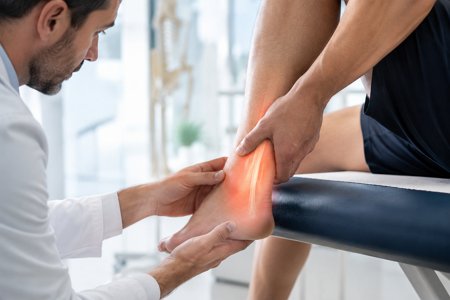
- Scale: it is the strongest and largest tendon in the human body.
- Anatomy: it connects the calf muscles to the heel bone.
- Function: the main task of this structure is to provide plantar flexion of the foot, which is the basis for all its movements.
Despite its high strength and resilience, injuries and diseases of the Achilles tendon are a common reason for visiting an orthopedic traumatologist, especially among athletes and people with a high level of physical activity.
Achilles tendon pathologies may occur acutely as a result of trauma, or develop due to chronic exposure to a pathological factor, such as repeated microtrauma. Delayed diagnosis and treatment of Achilles tendon disorders directly affect the functional activity of the foot, with the risk of partial or complete loss of function.
The Achilles tendon can withstand enormous loads, sometimes exceeding a person’s body weight. However, an anatomical feature of this structure is a zone located slightly above the tendon attachment site. This area has reduced blood supply and is the most vulnerable to degenerative, dystrophic and traumatic changes.
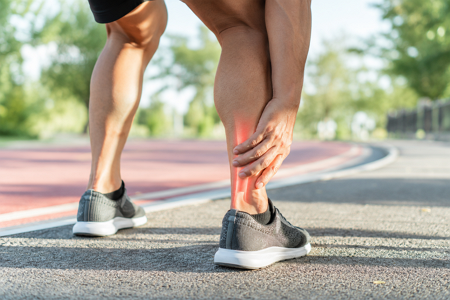
Risk factors for Achilles tendon pathologies include:
- Excessive physical activity
- Traumatic episodes
- Flat feet
- Excess body weight
- Loss of connective tissue elasticity with age
- Concomitant diseases, particularly those associated with connective tissue
It is also worth noting that the condition of the Achilles tendon may be affected by certain medications, such as fluoroquinolone antibiotics and systemic glucocorticosteroids.
Traumatic injuries of the Achilles tendon
Achilles tendon ruptures are among the most common and serious injuries in professional athletes. Unfortunately, today this pathology is also relevant for military personnel, as they are constantly exposed to excessive physical load on the lower limbs and feet in particular. Achilles tendon ruptures most often occur when landing on the feet after a jump, during a sudden start while running, or with a strong contraction of the calf muscles. Patients describe the sensation of a tendon rupture as a strong blow or a push in the heel area. A characteristic sign of an Achilles tendon rupture is a positive Thompson test — absence of foot movement during passive compression of the calf muscle. Restoration of Achilles tendon integrity is possible only surgically. A conservative approach involving prolonged immobilization of the limb followed by physiotherapy may be considered for patients who do not lead an active sports lifestyle.
Achilles tendinopathy
This is the most common pathological condition associated with the Achilles tendon. Its development is based not on a classic inflammatory process, but on primary degenerative structural changes caused by chronic excessive load.
A typical complaint in this pathology is pain along the back surface of the lower leg, which increases during physical activity. Morning stiffness in the foot and a palpable thickening in the tendon area may also occur.
It is important to remember that these complaints develop over time and gradually intensify. In other words, if at first a mild aching pain may seem like temporary discomfort, later, without proper attention to the problem, the pain will increase and pathological changes in the tendon will progress. Achilles tendinopathy is often associated with marginal bone growths of the heel bone — enthesophytes. They develop as a compensatory response to chronic tendon trauma.
The main direction of treatment for Achilles tendinopathy is therapeutic exercise and physiotherapy methods. Surgical correction is considered only when conservative treatment has shown no stable effect over a long period.
Achillobursitis
The pathogenesis of the disease is reflected in its name: inflammation of the synovial bursae located near the tendon.
Risk factors for this pathology include:
- chronic mechanical impact, for example from tight shoes
- anatomical features of the foot
- concomitant diseases, for example rheumatological conditions affecting connective tissue
Similar to tendinopathy, achillobursitis may cause localized palpable thickening of the skin at the tendon level, often accompanied by redness.
Conservative therapy for achillobursitis is aimed at reducing the inflammatory process and eliminating its cause: lifestyle modification, changing footwear, and systemic therapy for rheumatological diseases.
How are pathological changes of the Achilles tendon diagnosed?
To avoid losing the functional activity of the foot, it is recommended to consult an orthopedic traumatologist at Rudenko Medical Center in a timely manner. Not ignoring the problem is the key to a successful treatment outcome. Treatment fully depends on high-quality diagnostics. The basis for diagnosing Achilles tendon disorders is ultrasound examination — an accessible, fast, painless method that provides the clinician with answers to almost all necessary questions. In complex diagnostic cases, magnetic resonance imaging is additionally used.
Recovery after treatment of Achilles tendon pathologies
The speed of rehabilitation after treatment depends on many factors: from the complexity of the disease to the patient’s own discipline. However, the most important principles are always consistency, gradual increase of load and avoiding haste during recovery. Give yourself and your body time to recover fully. Rehabilitation programs are always developed individually, depending on the patient’s capabilities and physical fitness. Recovery measures are aimed at restoring the elasticity of the muscle-tendon complexes, as well as strengthening the muscular framework. Particular attention should be paid to the sequence and gradual increase of load on the limb. Excessive physical impact may trigger an exacerbation of Achilles tendon disease or cause a repeated rupture, which will significantly complicate further treatment and rehabilitation tactics for the patient.
Achilles tendon disorders are undoubtedly a relevant problem in modern medicine. A timely approach to diagnosis, treatment and rehabilitation in these pathological conditions helps preserve limb function and prevent loss of motor activity. The specialists of Rudenko Medical Center know exactly how to help you with this. Seek professional care and be assured: we are focused on achieving the best possible result for you.