
Joint pain is one of the most common complaints heard in a traumatologist’s office. Many patients also associate their painful sensations with weather forecasts or stressful events in their lives.
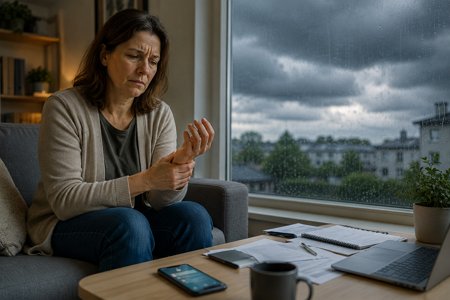 If you notice the following symptoms:
- morning stiffness in the joints during rainy weather;
- increased pain or aching sensations in the joints after stressful events;
- joint swelling during sudden changes in temperature, humidity, or atmospheric pressure,
these symptoms may have an underlying physiological cause.
Over time, medical science’s scepticism regarding weather-related joint sensitivity has been replaced by objective explanations of this phenomenon. Therefore, patients need to understand how this condition develops and learn to distinguish it from the actual progression of an existing disease. This helps determine when lifestyle changes may be sufficient and when it is necessary to consult a doctor at the Rudenko Medical Centre.
Why do joints react to changes in the weather?
Today, scientists tend to explain this phenomenon as the body’s response to changes in atmospheric pressure. The process is associated with how body tissues react to changes in the balance between internal and atmospheric pressure. When environmental pressure decreases, the volume of certain body structures may change slightly, particularly in areas where inflammation or scar tissue is already present.
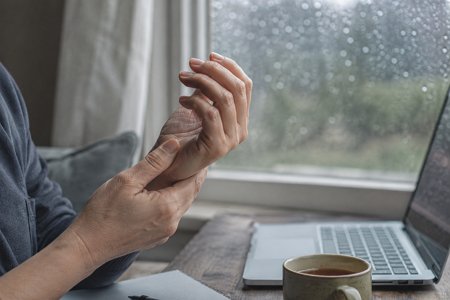 Cartilage and bones themselves do not feel pain. Pain is always associated with nerve supply. Irritation of nerve endings may therefore occur, causing pain, discomfort, and a feeling of pressure or fullness. Patients commonly describe these sensations as:
- aching pain;
- a dull, sore feeling;
- stiffness and limited active movement.
What about the ambient temperature?
The way joints react to outdoor temperatures can be explained even more simply. Cold causes blood vessels to constrict reflexively, reducing the blood supply to the tissues surrounding the joints and increasing muscle tone.
As a result, joint mobility may decrease, while existing pain may appear or become more intense. Increased joint pain is also sometimes reported when air humidity rises. However, the exact connection between humidity and joint pain has not yet been conclusively established.
Which patients are most likely to be weather-sensitive?
Some patients are more likely to experience joint reactions to changing weather conditions. These include:
- older adults;
- patients with degenerative osteoarthritis;
- patients with joint diseases involving an autoimmune component;
- patients who have previously sustained traumatic joint injuries.
These features are associated with the fact that such conditions may involve the deterioration of articular cartilage and chronic inflammation. After an injury, damaged areas can also become considerably more sensitive because the integrity of the bones or ligaments has been affected. Therefore, even minor fluctuations in atmospheric conditions may cause joint discomfort.
Weather-related joint reactions may also occur in patients following the replacement of large joints. These changes can be caused by fluctuations in pressure and the development of local swelling in the periarticular tissues. Such symptoms are reversible and usually disappear completely after the postoperative wounds have healed.
A traumatologist’s view of weather-related joint sensitivity
The professional team of traumatologists at the Rudenko Medical Centre is always ready to provide assistance, adjust your treatment, or select the most comfortable supportive solution if joint pain becomes more intense during changes in the weather. However, it is important to remember that weather changes do not cause joint disease. Only joints that already have structural changes tend to become weather-sensitive. It is therefore necessary to distinguish temporary worsening that can be managed in time from symptoms that require a consultation with a traumatologist.
During the examination, the doctor will assess the appearance of the joint, the nature of the pain, whether the symptoms coincide with weather changes, and how quickly they subside.
If the pain is occasional, resolves on its own without additional medication, and does not affect the function of the limb, it may indeed be associated with joint sensitivity to changing weather conditions.
However, if weather sensitivity is accompanied by:
- an increase in the size of the joint;
- redness or tissues that feel hot to the touch;
- a crunching or grinding sensation;
- a sudden reduction in the range of active movement in the joint;
- pain at night,
these are warning signs, and a visit to a traumatologist should not be postponed.
Such symptoms require further examination regardless of the weather outside, as they may indicate other pathological processes.
For this reason, patients’ complaints should not be ignored. Any deterioration in their condition requires attention. The first priority in such cases is to rule out organic changes in the joints. Various diagnostic methods can be used for this purpose, including X-ray imaging, computed tomography, and magnetic resonance imaging. These examinations help rule out fractures, damage to intra-articular and periarticular structures, inflammatory processes, and destruction of joint tissues. Experience, clinical reasoning, and critical assessment are all essential components of the effective approach used by the specialists at the Rudenko Medical Centre in every clinical case.
Can you live a normal life with weather-related joint sensitivity?
It is not always possible to eliminate the joints’ reaction to the weather completely, but it is possible to help them cope with weather changes more easily.
- check the weather forecast in advance
This allows you to prepare in advance and anticipate the possible onset of pain. Any necessary medication, such as pain relievers, can be kept close at hand so that the pain does not catch you by surprise. Being prepared means being better equipped to manage discomfort.
- plan your day
Make sure you have enough time to rest your joints or change activities so that they do not remain in one static position for too long.
- choose light, comfortable clothing
Avoid high heels and uncomfortable clothing when a change in the weather is expected. This will help prevent excessive strain on the joints and reduce additional discomfort.
- maintain a healthy weight
The reason is straightforward: excess body weight creates additional pressure on all joints, not only those that are already painful. This additional strain is undesirable.
- maintain regular and appropriate physical activity
Controlled physical activity has a positive effect on joint health. Regular movement that does not place excessive pressure on the joints helps strengthen the musculoskeletal system as a whole.
- consider periodic courses of therapeutic exercise or physiotherapy
Discuss the possibility of supportive procedures with your doctor. They can often serve as an effective addition to medication or provide support during periods when physical activity is limited for any reason.
Joint pain during weather changes is not a separate disease requiring specific treatment, but it is a genuine condition that deserves attention. An orthopaedic traumatologist at the Rudenko Medical Centre can help you adapt to such situations and improve your well-being. A comprehensive approach, attention to detail, and care for every patient can help ensure that no change in the weather prevents you from living without joint pain.